The real threat of AI isn't technology. It's economics
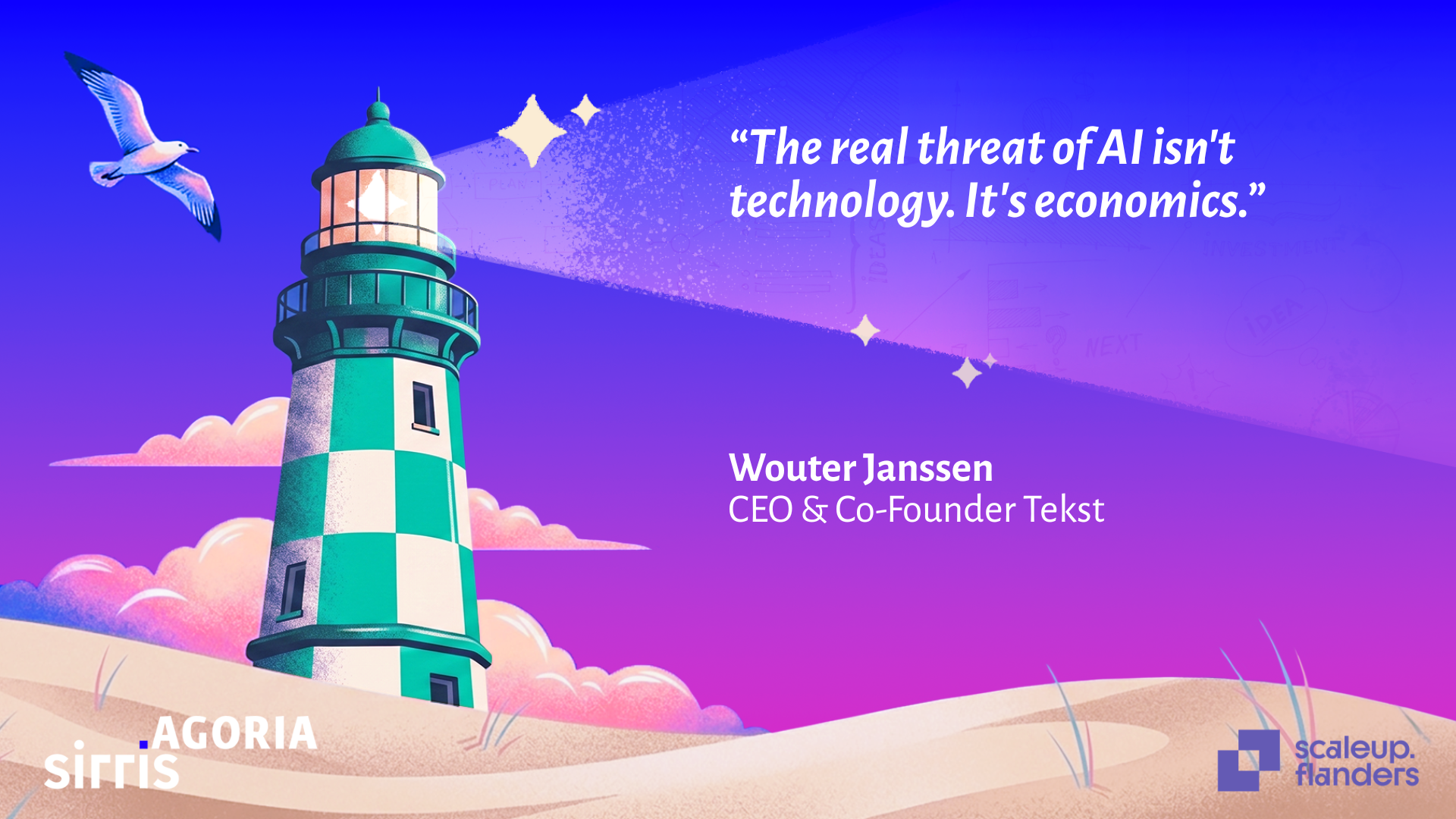

“The question is no longer whether AI will fundamentally change industries. It will. The real question is how much further it will have progressed a year from now, and whether your company is preparing for that possibility today.”
The real threat of AI isn't technology. It's economics.
Most founders are still focused on AI tools, copilots and productivity gains. According to Wouter Janssen, co-founder of Tekst.ai, that's only part of the story. The real disruption is happening at the business model level: pricing pressure, customer retention, competitive advantage and the ability to stay relevant when software becomes dramatically easier to build. At the AI Summer School this September, Janssen will share what founders need to understand about the economics of AI transformation.
What is the biggest misconception founders still have about AI?
Wouter Janssen: “I think many founders still underestimate how quickly AI is evolving.”
“If you're making three-year plans today, I'd be very cautious. Personally, I'd shorten a lot of planning horizons to 12 or 18months. The technology is improving so rapidly that long-term roadmaps become increasingly difficult to predict.”
“The question is no longer whether AI will fundamentally change industries. It will. The real question is how much further it will have prog ressed a year from now, and whether your company is preparing for that possibility today.”
If you were running a SaaS company with €5–10 million inrevenue, what would keep you awake at night?
Janssen: “The first challenge is organisational. Companies at that stage have already built teams, structures and processes. Changing direction becomes harder than when you're starting from scratch.”
“But the bigger concern is whether your product is truly defensible. Customers are becoming more critical about software spending. They're looking much more closely at which tools create real value and which ones can be replaced.”
“If your product isn't deeply embedded in a customer's organisation, AI is making it easier than ever for alternatives to emerge.”
What makes a software company defensible in an AI-driven market?
Janssen: “You need more than a feature. You need to become part of the customer's future architecture.”
“The companies that will thrive are those that solve multiple problems, integrate deeply into workflows and continue creating new value over time. If you're only solving a single isolated problem, competitors can emerge very quickly.”
“That's why I'm paying close attention to expansion revenue and upselling. If existing customers continue buying more from you, it's a strong signal that you're becoming increasingly relevant. If they don't, that's a warning sign founders should investigate.”
Can incumbents still win, or will AI-native companies dominate?
Janssen: “Incumbents absolutely still have a future.”
“Sometimes we look at Silicon Valley and assume every established company will disappear overnight. That's simply not reality. Large companies still have scale, distribution, customer relationships and resources that remain extremely powerful.”
“The opportunity for startups is often not to replace incumbents entirely, but to fill the gaps they cannot address quickly enough.The winners will be the companies that create the most value, regardless of whether they're five years old or fifty.”
How will AI change the way companies build teams?
Janssen: “I think we'll hire fewer narrowly specialised profiles and place more value on people who combine multiple skills.”
“Ten years ago, you often hired a different person for every function. Today, one strong employee supported by AI can accomplish far more than before. That doesn't mean teams disappear, but it does mean organisations can become leaner and more efficient.”
“The companies that adapt fastest will be those that redesign their organisations around that new reality instead of simply adding AI on top of existing structures.”
Why is the AI Summer School relevant today?
Janssen: “Because the most important AI questions are no longer technical.”
“Founders need to think about pricing, customer value, organisational design and competitive advantage. Those are difficult conversations, and there are very few playbooks available today.”
“The best way to navigate that uncertainty is by learning from other founders and operators who are facing the same challenges. That's why I believe initiatives like the AI Summer School are particularly valuable right now.”
AI Summer School takes place from 9–11 September inOstend and brings together a select group of founders and senior leaders toexplore how AI is reshaping organisations, teams and business models. WouterJanssen will lead a session on The Economics of AI Transformation andexplain what founders need to understand when capabilities become cheaper, customer expectations rise and traditional software advantages start to erode.
👉 Interested? Check https://www.scaleupflanders.com/services/ai-summer-school-2026
Is your tech company ready to scale up?Learn from experienced speakers and peers
Read next
View all