SAAS founders wonder whether their company will still be relevant in a few years

It has never been easier to build a company, but also never harder to differentiate yourself sustainably
Scaleup Flanders launches an exclusive AI Summer School for founders and C-levels of startups and scale-ups
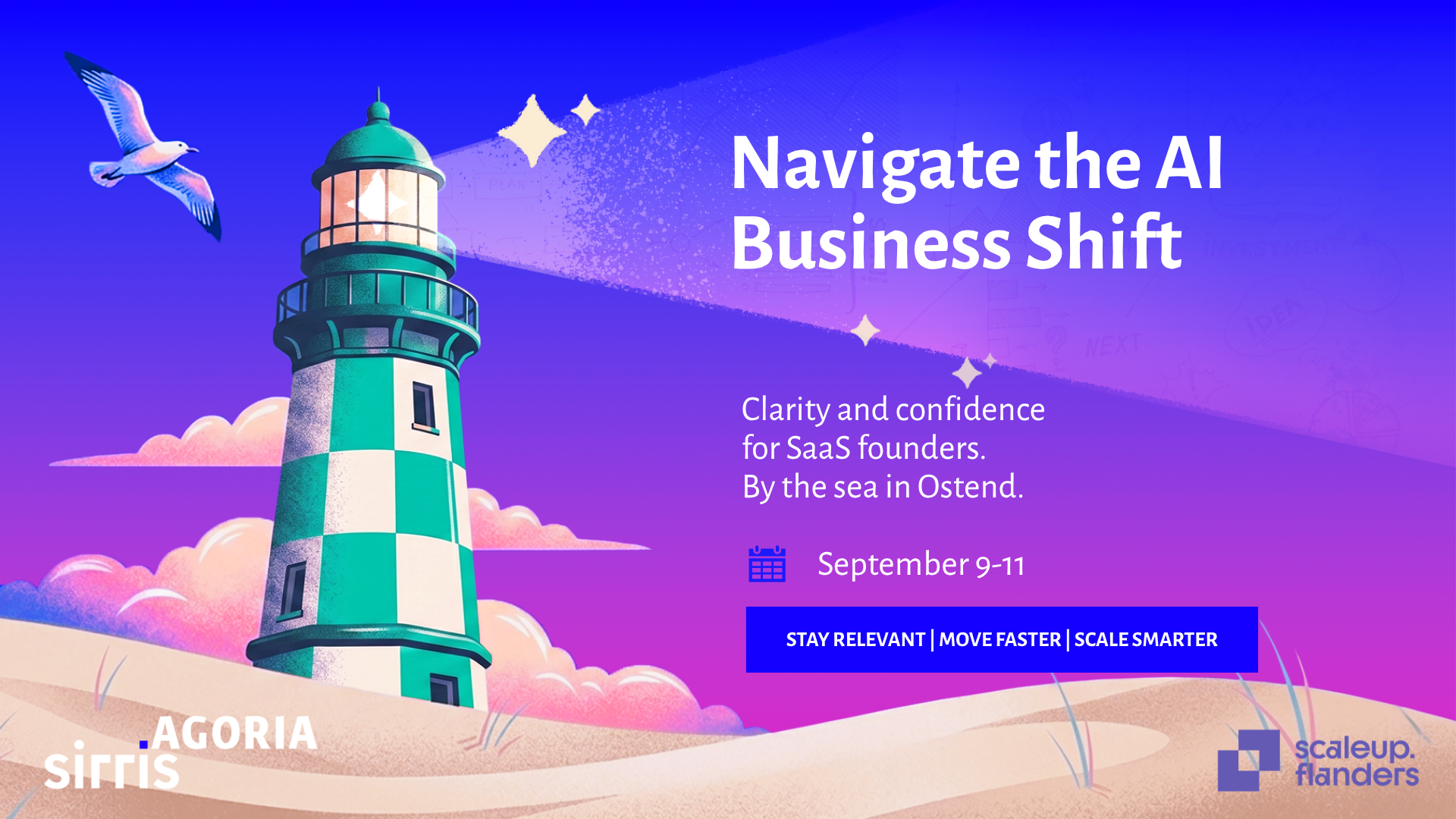
From 9 to 11 September, Agoria, Sirris and Scaleup Flanders are organising, for the first time, an AI Summer School for founders and C-levels of Belgian startups and scale-ups. This is not a training on the latest tools, but an exclusive two-day programme centred around a much more fundamental question: how do you build a relevant and competitive company in a world where AI is rewriting the rules? We spoke about this with Frederik Tibau from Agoria.
Why are you launching an AI Summer School now?
Frederik Tibau:
“Because founders themselves are asking for it. Over the past few months, we’ve had dozens of conversations with entrepreneurs from our startup and scale-up community, and the challenges they face have completely changed again.
A year ago, discussions were still about tools. Which applications are interesting? How can we work more efficiently? Today, conversations have become much more strategic. Founders are asking what AI means for their business model. Whether their product will still be sufficiently differentiated in five years. How they can compete with AI-native players that seem to achieve the same results with a fraction of their team.
These are questions that go to the core of a business. And that’s exactly why we felt it was time to build a programme that focuses on this, because it doesn’t exist yet in Belgium.”
Is AI an opportunity or a threat for startups?
Tibau:
“Both. We’re seeing companies emerge today that achieve with ten to twenty people what used to require a hundred. Barriers to entry are dropping, product development is accelerating, and international expansion is becoming more accessible. But at the same time, competition is increasing exponentially.
For many SaaS companies, there’s an additional challenge: which parts of their product will customers still be willing to pay for tomorrow, as AI makes certain functionalities cheaper and cheaper? It has never been easier to build a company, but also never harder to differentiate yourself sustainably.”
Many companies are experimenting with AI today. Isn’t that enough?
Tibau:
“Experimenting is relatively easy. You can give employees access to AI tools, automate certain processes and achieve productivity gains. Valuable — but it doesn’t fundamentally change your business.
I compare it to the rise of the internet. The companies that won weren’t necessarily those that were first to build a website. They were the ones that understood the internet would reshape their industry and adapted their organisation accordingly.
I feel that same dynamic again today, but faster and more intense. I see companies congratulating themselves for becoming ten percent more efficient. Meanwhile, someone in Berlin or London is building a competitor with five people that does the same thing at a fraction of the cost. That ten percent won’t save you.”
Does this mean companies will soon operate with fewer people?
Tibau:
“That’s too simplistic a way of looking at it. The question I hear most often is not how many people companies will need, but which people.
The honest truth is that some roles that exist today will no longer exist in three years. Not because AI replaces people, but because no rational founder will hire for them anymore. Think of certain operational tasks in finance, legal, HR or customer service — areas where AI can already support or automate a significant portion of the work.
Few people say this out loud. But in private conversations, you hear it more and more often. The question is not whether this will happen, but how fast, and whether your company is ready.”
What impact does this have on leadership?
Tibau:
“A bigger one than many people realise today. AI is increasingly moving into tasks that used to be typical management work: planning, forecasting, reporting, resource management. This doesn’t mean managers will disappear, but their role will change significantly.
Leaders will spend less time on control and coordination, and more on setting direction, building culture, and guiding people through change. Entrepreneurship remains about people — but the way leaders create value is shifting.”
Are startups better positioned than large companies to make this transition?
Tibau:
“In many cases, yes. Startups can move quickly. They have less legacy, less internal complexity, and less fear of questioning existing assumptions. But the pressure is also greater than ever.
A Belgian startup competes from day one with companies in London, Berlin, Stockholm or Silicon Valley. Many of these new AI-native players operate with smaller teams, develop faster and scale faster. As a result, speed is once again becoming one of the most important competitive advantages. For a scale-up, AI is not primarily about efficiency — it’s about speed. How fast can you launch new products, enter new markets, dominate a category?”
What keeps business leaders awake at night?
Tibau:
“Not so much AI itself. What keeps them awake is uncertainty. I regularly speak with founders who have built successful companies over ten or fifteen years — people who know their market inside out. And yet you increasingly hear the same underlying concern.
What if the rules of the game change? What if the organisation that got us here is not the one that will take us to the next phase? What if a competitor with twenty people soon achieves what we need a hundred people for? These are not theoretical questions anymore. These are questions about competitiveness and future-proofing.”
What can participants expect from the AI Summer School?
Tibau:
“We deliberately limit participation to thirty founders and C-levels, all dealing with similar strategic questions. That creates a very different dynamic from a traditional conference.
We combine inspiring sessions with national and international experts from organisations such as ML6, TechWolf, Sortlist, Luzmo, Peripass and Phished, with workshops where participants actively work on their own organisation, processes and growth strategy. Because ultimately, it’s not about what AI means for companies in general — it’s about what it means for your company.
Our goal is that participants go home on Friday evening with new insights and concrete decisions they can start implementing on Monday.”
Why shouldn’t a founder miss this?
Tibau:
“Because this is one of the most important strategic questions you can ask as an entrepreneur today: is the company I’ve built also the company that will still be relevant in five years?
Many companies still treat AI as a technology project. We believe it is fundamentally an entrepreneurship project. And that question deserves more than a two-hour workshop. It deserves two and a half days, a small group of like-minded entrepreneurs, and the space to truly reflect on it.”
Is your tech company ready to scale up?Learn from experienced speakers and peers
Read next
View all

.png)