Eat your own banana: how AI is reshaping tech scale-ups


if artificial intelligence is going to undermine your business model, it is better to build the company that could disrupt you yourself than to wait for somebody else to do it.
Giving employees access to Claude is the easy part. The real challenge is deciding what remains valuable when software becomes cheaper to build, AI agents start doing the work and yesterday’s competitive advantage can be copied overnight. During Agoria’s AI Summer School, one uncomfortable question dominated the debate: if you started your company today, would you still build the same business?
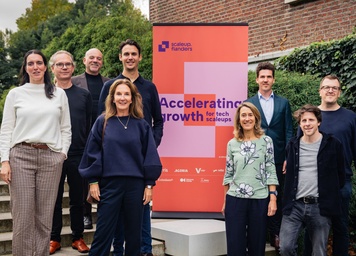
“Eat your own banana” was one of the more unusual phrases heard during two and a half days of discussions between 30 founders and executives in Thermae Palace Ostend. But the message behind it was serious: if artificial intelligence is going to undermine your business model, it is better to build the company that could disrupt you yourself than to wait for somebody else to do it.
That prospect is becoming increasingly real for technology scale-ups. Generative AI is reducing the cost of writing software, analysing information, producing content and automating business processes. Features that once required months of development can increasingly be reproduced in weeks or even days.
At the same time, AI agents are beginning to do more than help users operate software. They are starting to perform the work for which customers previously bought that software. This places a question mark over one of the dominant technology business models of the past decade: software as a service.
Electrifying the old factory
Several speakers compared the arrival of AI with the introduction of electricity in manufacturing. The first factories simply replaced their central steam engine with an electric motor while retaining the same layout and system of belts. The real productivity leap came later, when factories were redesigned around smaller motors and entirely new production flows.
Most companies today are still in the first phase. They distribute licences for ChatGPT, Claude, Copilot or Cursor,encourage employees to experiment and automate individual tasks. That may save time, but it does not fundamentally change how the company creates value.
The harder step is to redesign the organisation around what AI now makes possible.
Wim Codenie of Sirris captured the distinction in three words: adopt, automate, adapt. Adoption has rapidly become a basic operating cost. Automation creates efficiency, but rarely a durable advantage. Adaptation means reconsidering the product, the organisation and even the activities a company should stop performing.
That is where strategy begins. Companies spend considerable time asking what AI can do. Far fewer have decided what they deliberately do not want it to do.
Human judgement, responsibility and customer trust emerged as recurring answers. AI may prepare a recommendation, generate code or identify a commercial opportunity. Somebody still has to determine whether the result is correct, appropriate and safe, and accept responsibility when it is not.
This creates a paradox: the more execution AI takes over, the more valuable experienced human judgement becomes.
It also raises a longer-term problem.Junior employees traditionally acquired judgement by doing the routine work that AI is now absorbing. If companies remove those entry-level tasks, they must find a new way to develop the experienced specialists they will need five years from now.
“If AI can perform 90% of what customersneed from you, what is the remaining 10% that becomes exceptionally valuable?”
What is your valuable 10 percent?
Anita Schjøll Abildgaard, co-founder of theNorwegian AI company Iris.ai, framed the challenge through what she calls the“10 percent question”.
The answer will differ from business to business. It may be specialist expertise, verification, accountability, customer understanding or the ability to make decisions in an ambiguous context. But that remaining 10 percent could contain the company’s future value proposition.
The same reasoning applies to competitive advantage. Access to AI is not a moat when competitors can use the same models. More defensible assets may include proprietary company context, deeply embedded systems of record, accumulated process knowledge, integrations, distribution and trusted customer relationships.
The central question is therefore not howmuch AI a company uses, but what it possesses that remains scarce when intelligence becomes abundant.
When SaaS starts doing the work
The most disruptive consequence may be the blurring of the boundary between software and services. The conventional SaaS model gives customers tools with which they perform a task. But if an AI agent can operate the tool, why stop at selling the software? A vendor could use its technology to deliver the desired outcome directly.
An accounting software company, for example, can remain a supplier to accountants. Or it can use software and AI to become an accounting firm itself.
That is the model behind Die van de Boekhouding, the AI-first accountancy company built by former Silverfin co-founder Tim Vandecasteele. It illustrates a broader shift from software as a service towards services built on software.
For existing SaaS companies, that opportunity comes with an obvious danger: moving down the value chain may put them in direct competition with their own customers.
Yet doing nothing may be more dangerous. If agents increasingly perform the work inside software, interfaces, dashboards and individual product features become less valuable. What remains defensible is often buried deeper: the system of record, accumulated process knowledge, integration into customer operations and the accountability enterprises expect from a trusted supplier.
Adding an AI assistant to an existing product may improve it, but it does not necessarily change the underlying competitive position. The more fundamental question is whether a company should continue selling the tool or start delivering the outcome.
AI also changes the economics of a technology company.
Software may become cheaper to build, but AI-native companies are not necessarily cheaper to operate. Model usage, infrastructure, evaluation and human supervision introduce new variable costs. At the same time, traditional seat-based pricing becomes harder to defend when the product’s purpose is to reduce the number of people doing the work. Founders may have to accept temporarily lower margins, rethink what they charge for and develop pricing models based on usage or completed work rather than users.
New bottlenecks, new roles
AI does not simply eliminate work. It moves the bottleneck.
In software development, generating code is becoming faster. Reviewing, testing and validating it consequently take on greater importance. The scarce capability is no longer just the ability to produce something, but the expertise to distinguish robust output from something that merely looks plausible.
Roles are beginning to change as a result. Engineers increasingly combine product decisions, implementation, testing and customer understanding. Companies are also experimenting with specialists who design the context, evaluations, permissions and controls surrounding AI systems, or with engineers who work closely with customers to turn prototypes into operational solutions.
The foundation model itself may increasingly become interchangeable. The infrastructure around it (company context, routing, security, evaluation and integration) is where much of the real work and differentiation lies.
The same shift affects sales and marketing. AI can handle more research, segmentation, preparation and follow-up, but the customer relationship remains human. Automating a weak commercial strategy mainly produces generic outreach at greater speed. AI becomes valuable only when it is built on a deep understanding of the customer.
Buying licences is not transformation
The technology may be new, but the most difficult obstacle is familiar: changing human behaviour.
Several participating companies had reached the same conclusion through different routes. Simply buying licences did not ransform their organisation.
Some imposed a temporary break with the old way of working. Others made AI experimentation part of performance reviews or asked managers to present concrete implementation plans. Another company deliberately created a voluntary expert group without managers to build support from within the organisation.
There was no consensus on whether adoption should be forced from the top or encouraged through internal enthusiasts. There was agreement on one point: passive access to tools is insufficient. Leadership must create conditions that alter behaviour.
Leaders also need to use the technology themselves. They cannot redesign roles, processes and accountability solely through presentations or consultants. Without hands-on experience, they cannot properly judge what AI can do, where it fails or how its use affects employees.
That challenge extends beyond those who resist AI. Employees who embrace it enthusiastically face a different risk: running several agents in parallel, processing a constant stream of output and shifting their working day from creation towards uninterrupted supervision. Higher productivity can come with cognitive overload and new forms of burnout.
No playbook
The Summer School did not produce a universal formula for becoming AI-native. That may be its most honest conclusion.
Some companies favour open models and self-hosting; others use the most capable commercial models available. Some force adoption; others depend on volunteers. Some expect smaller teams, while others maintain headcount and aim to multiply output.
Long-term AI roadmaps are particularly fragile because their assumptions expire so quickly. A more realistic approach is to make a small number of short bets: experiment, measure, learn and adjust.
That does not mean strategy has become irrelevant. It means strategy must focus less on predicting exactly which technology will win and more on identifying which assumptions about the existing business should be tested now.
Four questions capture the challenge:
1. If AI can do90% of the work, what is your valuable 10%?
2. What remains scarce when everyone has access to the same intelligence?
3. Are you still selling the right product or should you deliver the outcome?
4. If you started today, would you build the same company?
If the honest answer to the final question is no, the most dangerous competitor may be the company you are still refusing to build. In other words: eat your own banana before somebody else does.
This article captures some of the main insights from the first Scaleup Flanders AI Summer School. Contributions made under the Chatham House Rule have not been attributed to individual participants or their companies.
The AI Summer School was organised byScaleup Flanders, an initiative of Agoria and Sirris, supported by VLAIO.
Is your tech company ready to scale up?Learn from experienced speakers and peers

Read next
View all